

We’re Not Becoming Specialists With AI. We’re Becoming Operators of Outcomes.
Why AI is a knowledge compressor that makes deep specialization a liability, not a safety net

There’s a comforting myth people still cling to in tech and knowledge work: “If I specialize deeply enough, I’ll be safe.” We see it all the time. All I need is that Cisco certification to be in demand. Pass the CFA exam and unlock job security and wealth. For decades, this was true. Difficulty was a moat; specialized knowledge was scarce.
But in the AI era, this logic is inverting. AI is a universal solvent for deep, technical moats. If your job can be cleanly isolated, specified, and benchmarked, it is exactly the kind of thing an agent will absorb. The risk isn’t being a generalist. The risk is being too legible to automation.
And here’s the mechanism: AI is a knowledge compressor. It takes vast, deep verticals of information, such as the entire corpus of Cisco documentation, financial regulations, or legal precedents, and compresses them into instantly retrievable utility. The human who memorized the manual is no longer the gatekeeper. The syntax, the formula, the formatting, all of it has been friction-ized away.
This week, there was a very interesting signal in the Financial Times article about McKinsey, which was not what its headline describes, which is that they’re using AI in interviews. It’s what they’re testing for.
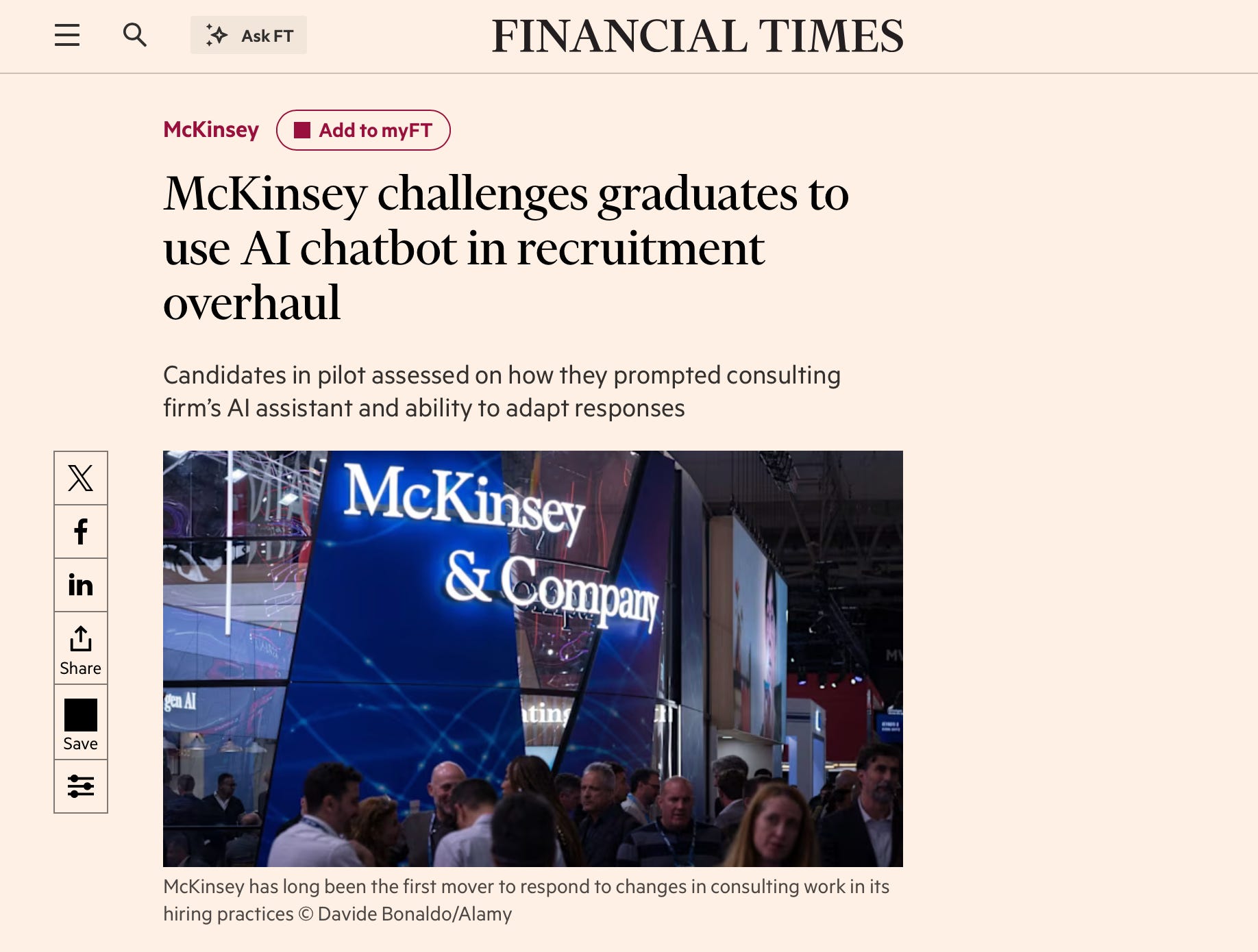
They aren’t testing for answers, correctness, or frameworks. These days, if you want an analyst role at the company, candidates must demonstrate judgment, curiosity, and adaptability. These aren’t “soft skills” anymore. These are anti-automation skills.
The Shift from “How” to “Why” (or: Why Syntax Became Worthless Overnight)
In the past, the barrier to entry was the “How.” The syntax of a command line. The specific formula for a derivative. The complex formatting of a legal brief. Specialists were paid to navigate this friction.
AI creates a friction-free layer over complexity. A generalist can now execute complex “How” tasks like “Write a Python script to scrape this data” without knowing the syntax. The code appears. The formula computes. The brief format itself.
Value is migrating upstream to the “What” (strategy) and the “Why” (ethics, purpose, judgment). Judgment is now scarcer than execution. This is the inversion: we used to hire people who could execute and hope they’d develop judgment. Now we need judgment first, and execution is becoming table stakes through tooling.
Liberal Arts Aren’t a Nostalgic Detour. They’re a Hedge Against Discontinuity.
When Bob Sternfels, the global managing partner at McKinsey, says liberal arts graduates bring “truly novel” thinking that complements AI’s inability to make “discontinuous leaps,” that’s an observation that goes beyond HR rhetoric.
AI is phenomenal at interpolation, pattern completion, and compression of prior work. It thrives in predictable domains with fixed rules. A dermatologist diagnosing a specific lesion (deep specialization) is more at risk of automation than a general practitioner managing a patient’s overall holistic health (broad context).
AI is great at summarizing a problem but bad at reframing the problem, rejecting its premises, and sensing when the question is wrong.
That’s exactly what philosophy, literature, history, and the arts train you to do.
For decades, we optimized education for local maxima: finance majors for finance jobs, CS majors for engineering ladders, MBAs for management pyramids. AI collapses those ladders.
What survives are people who can move sideways, not just climb upward.
The Silo Vulnerability: Why Deep Specialists Are Sitting Ducks
Here’s the uncomfortable truth: deep specialists often work in silos. They navigate in isolated environments with predictable rules. A specific accounting standard. A particular networking protocol. A narrow regulatory framework.
AI thrives in silos. It is actually better at deep, narrow, rule-based tasks than it is at broad, chaotic, cross-domain tasks. The narrower the domain, the easier it is to train a model on it.
Deep specialization is not a bunker. It’s a target.
The most secure workers are not those who dig one hole deeply, but those who can connect Dot A (Finance) to Dot B (Tech) to Dot C (Psychology). If AI provides the raw intelligence blocks, the value-adding human is the architect who puts them together.
Call it combinatorial creativity. Wealth will accrue to those who can synthesize AI-generated outputs across domains to solve novel problems. The future isn’t I-shaped (deep in one thing) or even T-shaped (deep in one, broad in others). It’s M-shaped: multiple peaks of competency, because AI has lowered the learning curve enough that professionals must now have multiple areas of fluency to remain competitive.
The Half-Life of Skills: Why Certifications Are Printed Maps in an Era of Shifting Plates
Here’s the brutal math: technical skills rot faster than they used to. A certification earned in 2023 may be obsolete by 2026. AI updates code libraries and financial regulations in real-time. Relying on a static certification today is like relying on a printed map in an era of shifting tectonic plates.
And it gets worse. The frontier of value isn’t a straight line anymore (harder stuff = more money). It’s jagged and unpredictable. AI might conquer a specific “hard” peak tomorrow while leaving some adjacent, “easier” tasks untouched. Betting your career on one specific hard skill is a bet on a single point on a jagged, moving frontier.
The new “specialization” is adaptability itself. The ability to learn a new tool, use it, and discard it when it breaks. That’s the new CFA.
One Agent per Human Is Not a Metaphor. It’s a Unit of Production.
The most under-discussed line in the article is this: McKinsey has a “workforce” of 20,000 AI agents in addition to its 40,000 staff, moving toward “one agent per human.”
Let us just think what this means. Historically, one manager oversaw ten analysts, software was priced per seat, and productivity scaled with headcount. Teams could only get bigger.
Fast-forward to today, and one human orchestrates N agents; software is priced by usage, success, and outcome, and productivity scales with orchestration skill. In this world, human teams can only get smaller.
This reality is already reflected in AI pricing, which looks less like SaaS and more like electricity: standing charges, consumption-based pricing, and performance premiums.
We are watching the utility-ization of cognition.
And utilities don’t care how many people are on your team. They care how much output you draw.
Consulting Is the Canary Because Consulting Is Pure Leverage
McKinsey matters here because it’s upstream. What McKinsey does or advises to do sets practices and behaviors across the economy.
For decades, it has been a training ground for elite talent, a distributor of managerial best practices, and a cultural blueprint for how “serious companies” operate.
When McKinsey reduces hiring, clients don’t just copy that behavior. They copy the logic behind it.
And the logic is simple: juniors are not less capable, they are less necessary.
If one operator with agents can do what ten juniors used to do, the surplus doesn’t get reallocated. It gets eliminated.
Which leads to the uncomfortable question no one wants to ask: what happens to the people whose jobs disappear because they succeeded at something that can be automated?
I Cut My Team Too. And That’s the Part That Scares Me.
This is where it stops being abstract.
Last year, I had freelancers for content, editing, and marketing. All of them were good people, reliable and talented.
I cut all of them.
And not because they were bad, but because I realized I could automate most of what they did.
And if I’m honest, the hardest part was letting go of the identity of “leading a team,” the feeling of importance that comes from coordination, and the social validation of being a mini-CEO.
Once you drop that ego layer, the cold efficiency is undeniable: fewer dependencies, less coordination overhead, no HR, no admin, no performance variance, and no emotional debt.
This is the logic millions of founders, managers, and operators are independently arriving at.
And collectively, it’s explosive.
From Activities to Outcomes (and Why That’s a Social Shock)
We are migrating from software, from work, from organizations toward outcomes instead of activities.
You’re no longer paid to analyze. You’re paid to decide. You’re not paid to produce slides. You’re paid to move metrics. You’re not paid to “support.” You’re paid to close loops.
While AI produces content regardless of whether it is code, analysis, or prose, humans provide context. A CFA creates a financial model; a human decides if that model makes sense given the geopolitical climate and the CEO’s divorce. That contextual judgment, that ability to say “this analysis is technically correct but fundamentally wrong for this situation,” that’s where value lives now.
AI thrives in outcome-based systems, while humans build identity around activity-based ones.
That mismatch is where the tension lives.
Because when outcomes matter more than effort, the market becomes brutally honest: fewer roles, higher expectations, and wider variance between winners and everyone else.
This is much more than a cyclical downturn. It’s a structural compression of labor demand.
2026 Is the Year of the Digital Coworker (and the Moral Test)
I’ve said it before, and I’ll say it again: 2026 is the year of the digital coworker.
These aren’t assistants. They aren’t copilots. They are coworkers.
They are digital twins, agent fleets, and autonomous operators.
I’m building one for myself.
And I’m conflicted about it because every task I automate is one I no longer pay someone else to do.
At scale, this becomes more than a personal optimization problem; it turns into a societal coordination failure.
If everyone acts rationally as an individual, the collective outcome may be irrationally unstable.
We don’t yet have language (let alone policy) for that.
The Real Question Isn’t “Will Jobs Disappear?”
They will.
The real questions are: who captures the upside? How do people re-enter the system? What do we value when efficiency is no longer scarce?
McKinsey is right to emphasize judgment over memorization. Liberal arts are right to reassert themselves. Generalists are not regressing. They’re resurfacing.
But unless we grapple seriously with where the displaced energy goes, we risk building the most productive economy in history with no social story to sustain it.
And that (not AI) is the real discontinuity.
If you’re interested in how AI is reshaping work, organizational design, and what happens when productivity decouples from headcount, follow me at @profrodai for more posts like this. I write about the rise of the AI Operator, agent engineering, and the transition from activity-based to outcome-based systems. You can find me at the Agent Engineering Community.